

Why Illinois?
01
Why Illinois?
Illinois is one of the most dynamic and diverse economic engines in the United States, home to the nation's fifth-largest state GDP and a leader in advanced manufacturing, agribusiness, and emerging technologies. Ranked second in the nation for corporate relocations and expansions, Illinois' success is driven by more than its industries—it is powered by the people and communities that make it thrive. From its highly skilled workforce to its collaborative spirit, Illinois has built a culture where businesses, workers, and communities grow together.

02
Did you know?
5th
Illinois is the fifth-largest economy in the U.S. and ranks as the nation's second-leading state for corporate expansion and relocation.
$34.7 Billion
The technology sector contributes $34.7 billion to the state's GDP, driven by 30,000 tech companies that employ more than 268,000 workers.
#6
Illinois ranks #6 in the nation for overall tech and innovation, becoming a leader in quantum computing and artificial intelligence
10.4%
High-tech industries account for 10.4% of the Illinois workforce, which has consistently grown by 3.5% annually, outstripping the 2.5% national average.
03
How will Data Centers play a valuable role in Illinois?
Economic Ripple Effect
The Data Center boom is projected to generate 240,000 temporary construction jobs, 35,000 permanent high-paying tech roles, over a 10-year horizon.
Tax Revenue
Data centers pay substantial local property and utility taxes. For example, in DeKalb, a major Meta subsidiary paid $48.5 million in property taxes from 2021 to 2024, funding local school districts. Statewide, the sector generated over $1.85 billion in combined state and local tax revenues.
Community Investment
Major tech companies operating in the state frequently invest in local nonprofits, workforce development, and higher education initiatives, such as STEM partnerships with Northern Illinois University.
03
How will Data Centers play a valuable role in Illinois?
Economic Ripple Effect
The Data Center boom is projected to generate 240,000 temporary construction jobs, 35,000 permanent high-paying tech roles, over a 10-year horizon.
Tax Revenue
Data centers pay substantial local property and utility taxes. For example, in DeKalb, a major Meta subsidiary paid $48.5 million in property taxes from 2021 to 2024, funding local school districts. Statewide, the sector generated over $1.85 billion in combined state and local tax revenues.
Community Investment
Major tech companies operating in the state frequently invest in local nonprofits, workforce development, and higher education initiatives, such as STEM partnerships with Northern Illinois University.
05
Illinois Data Center Success

04
Community Impact
Statewide: Data Center Investment Program
Illinois is the fifth-largest economy in the U.S. and ranks as the nation's second-leading state for corporate expansion and relocation.
Property Tax Relief and School Funding
DeKalb hosts Meta's hyperscale data center, which broke ground in 2020 and came online in 2023, growing toward more than 2.3 million square feet across five buildings. Meta has partnered with school districts to support them through paid property tax, rate relief with more services, and utility taxes.
Public Benefit
On March 20, 2026, the Joliet City Council approved an annexation agreement for a 795-acre data-center campus developed by Hillwood and PowerHouse Data Centers. With a ~2.1 billion projected tax revenue over thirty years, the City of Joliet can use this revenue for direct community investment, no abatements, job creation, and bolstering local educational institutions.
Adaptive Reuse: Replace Vacant Corporate Campuses
Several of Illinois' largest data-center projects redevelop distressed or abandoned corporate campuses, converting vacant office space that generates little tax revenue into high-value industrial use.
The following locations have been reused: Hoffman Estates (former Sears HQ), Mount Prospect (former United Airlines HQ), Itasca (Hamilton Lakes Office Park), and Wood Dale (CyrusOne).
Construction and Skilled Labor
The DCIP is, structurally, a construction-jobs program: every project requires a DCEO-approved Project Labor Agreement and Responsible Bidder Act compliance, so the building-trades workforce is organized by statute. In underserved areas, the 20 percent construction-wage credit flows directly to workers.
Permanent operations jobs are paid, by statute, at 120 percent or more of the average county wage, typically for electricians, HVAC technicians, data-center technicians, facilities, and security roles.
Resident Rebates
Elk Grove Village is the densest concentration of data centers in the Midwest: 20 operational facilities (including STACK, Microsoft, T5, SDC, Aligned, Digital Realty, EdgeConneX, and Equinix), with 19 more in the pipeline. The Village's economic-development strategy and Cook County Class 6(b) industrial incentive anchored the cluster, and cumulative reported DCIP investment there exceeds $3.7 billion. This has resulted in water-bill credits, gift cards, and new infrastructure.
Innovation and University Partnerships
Northern Illinois University + Meta (DeKalb). Launched in November 2023 and renewed annually through Meta's Data Center Community Action Grants, the partnership built the Barb City STEAM Studio on the NIU campus, runs the Barb City STEAM Team afterschool program and Huskie Engineering Camps, and has put 105 middle-schoolers through coursework in sensors, data, and AI.
Illinois Medical District + Metro Edge (Chicago West Side). Metro Edge Development Partners, Illinois' first African-American-led data-center development, signed a 75-year ground lease for the IMD1 facility, with 21 MW of capacity across 191,000 square feet on a 1.97-acre infill site.
Underserved-Community Investment
Of the 34 active DCIP agreements as of December 31, 2025, 16 are sited in DCEO-designated underserved areas and qualify for the added 20 percent construction-wage credit, driving wages into local communities. Reported investment in those projects includes Meta DeKalb ($4.59 billion), SDC Busse and SDC CHI I in Elk Grove Village ($637 million and $518 million), Digital Realty in Franklin Park ($404 million), Metro Edge IMD1 on Chicago's West Side ($257 million commitment), and additional projects in Des Plaines, Aurora, and Chicago.
Renewable Energy and Sustainability
DCIP eligibility requires every qualifying data center to demonstrate carbon neutrality or attain a recognized green-building standard within two years, a statutory floor, not a voluntary pledge. Operator commitments above that floor include Meta's DeKalb center running on 100 percent renewable energy since day one (2023); Microsoft's virtual power purchase agreement for roughly 389 MW of solar; and Digital Realty's commitment to match all 11 of its Illinois data centers with 100 percent renewable energy beginning in 2025. Aurora's March 2026 ordinance now requires future data centers to source renewable power and meet noise and water-efficiency standards.
05
Success with Data Centers
01

Elk Grove
Data Centers have been successfully operating in Elk Grove for 25 years. Known as the "Data Center Capital of the Midwest," the Village approved a $1 Billion expansion of data center investment. In the single year of 2025 alone, data centers generated approximately $61.6 million in total revenue. The village receives such a vast tax surplus, municipal leaders have historically used the funds to keep a lid on standard residential property taxes, support local infrastructure (schools, libraries, parks), and issue direct financial rebates to residents.
02
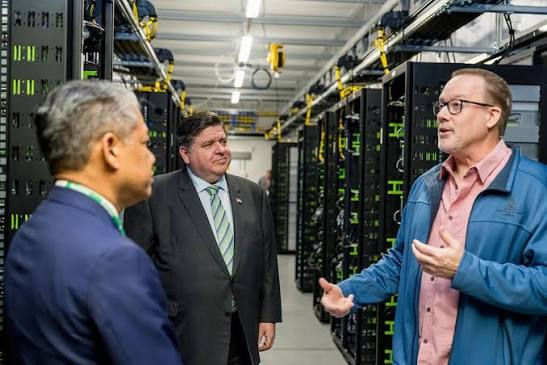
DeKalb
Meta’s DeKalb Data Center is a fully operational, $1 billion-plus facility spanning 2.3 million square feet. Located in the ChicagoWest Business Park in DeKalb, Illinois, it operates on 100% renewable energy and supports over 200 permanent local jobs. Since the operation, the Meta Data Center has not only paid over $46 million in property taxes but has also invested $1.2 million in additional funds for nonprofits, universities, and DeKalb-area schools.